A Canny alternative that tells you why
Canny is a polished home for feature requests: a board, votes, a roadmap and a changelog. Outcomify's feedback board does the collecting too, then keeps going. Every request becomes evidence of a customer need, counted by customer and linked to the discovery work that answers it. And it's MCP-enabled, so your AI agent can work it too.
Every month I copy the numbers into a spreadsheet by hand so our accountant can close the books.
- Get month-end numbers to our accountantHeard from 11 customers
- Share results with people who don't log inHeard from 6 customers
Where Canny stops and Outcomify keeps going
Both boards collect requests and tell customers what happened to them. The difference is what a request becomes once it's in.
A request is not a need
“Add an Excel export” is one customer’s guess at a solution. Canny ranks the request. Outcomify reads it into the need behind it (getting month-end numbers to an accountant) and groups everyone who shares that need.
Customers, not clicks
A vote count mixes one enthusiastic user with ten quiet accounts. Outcomify counts the customers behind a need across requests, interviews and tickets, so the number means people.
Scarce votes
Canny voting is an upvote. On Outcomify’s board everyone gets a small budget, up to three votes on any one request, so a vote tells you what someone would pick first.
Connected to discovery
Each request shows the opportunities in your Opportunity Solution Tree that cite its needs. A need many customers share that nothing answers is the row worth reading.
Outcomify vs Canny
Feature by feature, including where Canny is ahead.
Based on each product's public documentation at the time of writing. Canny changes too; check their site for the latest.
Why teams pick Outcomify's board
For teams who want the board to answer why, not just what.
Approved requests become evidence. Canopy reads them into needs, deduplicated across every source.
See which opportunities answer each request, and which well-supported needs nothing answers yet.
Seven votes each by default, up to three per request. Priority, not popularity.
Status notes and replies reach the person who asked by email, in your own words.
Requests, new supporters, what shipped and time to first reply, week by week and per customer group.
Connect Claude or any MCP client to ask what customers want that nobody has picked up, and to triage the board.
See what each request turned out to mean
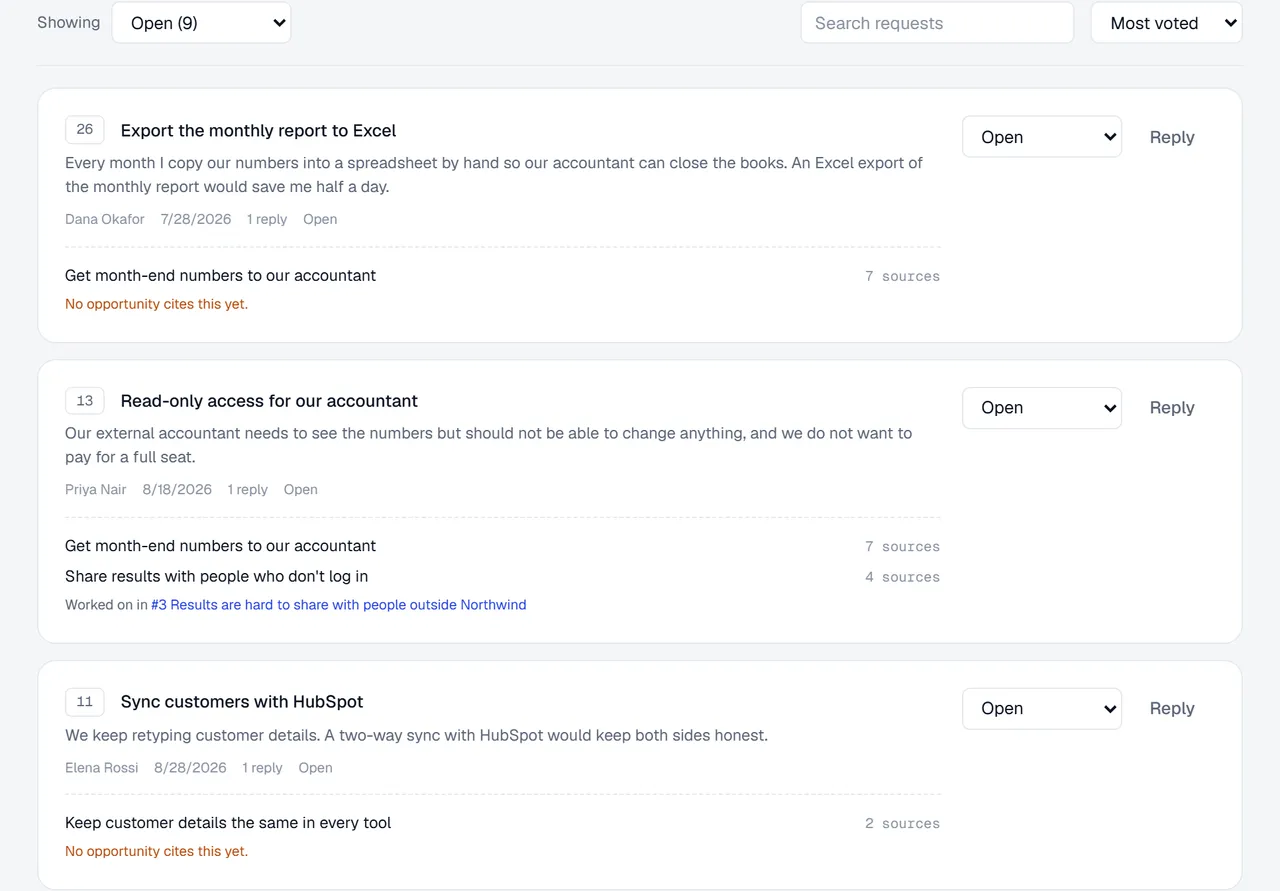
The inbox shows the needs behind every request, how much evidence stands behind each, and which opportunity in your tree is working on it. Requests wait for your approval before they count as evidence, so what the board says about your customers is something you chose to believe.
- The needs behind each request, with their evidence
- The opportunity working on each, or a plain “No opportunity cites this yet”
- Approve, turn down, or mark as spam before anything counts
- Every status in your own words
The honest take
When to pick Canny
Pick Canny if you want a mature, standalone feedback suite: a public changelog, your board on your own domain, feedback pulled in from support conversations, and ready-made integrations with issue trackers, chat and CRMs. It's very good at collecting and ranking requests.
Pick Outcomify if the board is the front door to your discovery work: you want each request read into the need behind it, customers counted once, and a clear line from that need to the opportunities you're working on.
Frequently Asked Questions
Common questions about Outcomify and Canny
Keep exploring
The Outcomify feedback board
How requests become evidence, votes become priorities, and customers hear back.
How to prioritize feature requests
Count customers, not votes: a method you can use with any board.
Productboard alternative
How Outcomify compares for discovery and Opportunity Solution Trees.
Pricing
Free with full access during our pilot.
See what your requests actually mean
Set up a board in minutes, approve the first requests, and watch the needs behind them appear.